
A Turbo Boost for Computers: Computing with Light Saves Time and Energy
-
place:
KIT press release 072/2026 (german)
- date: 18.8.2026
A Turbo Boost for Computers: Computing with Light Saves Time and Energy
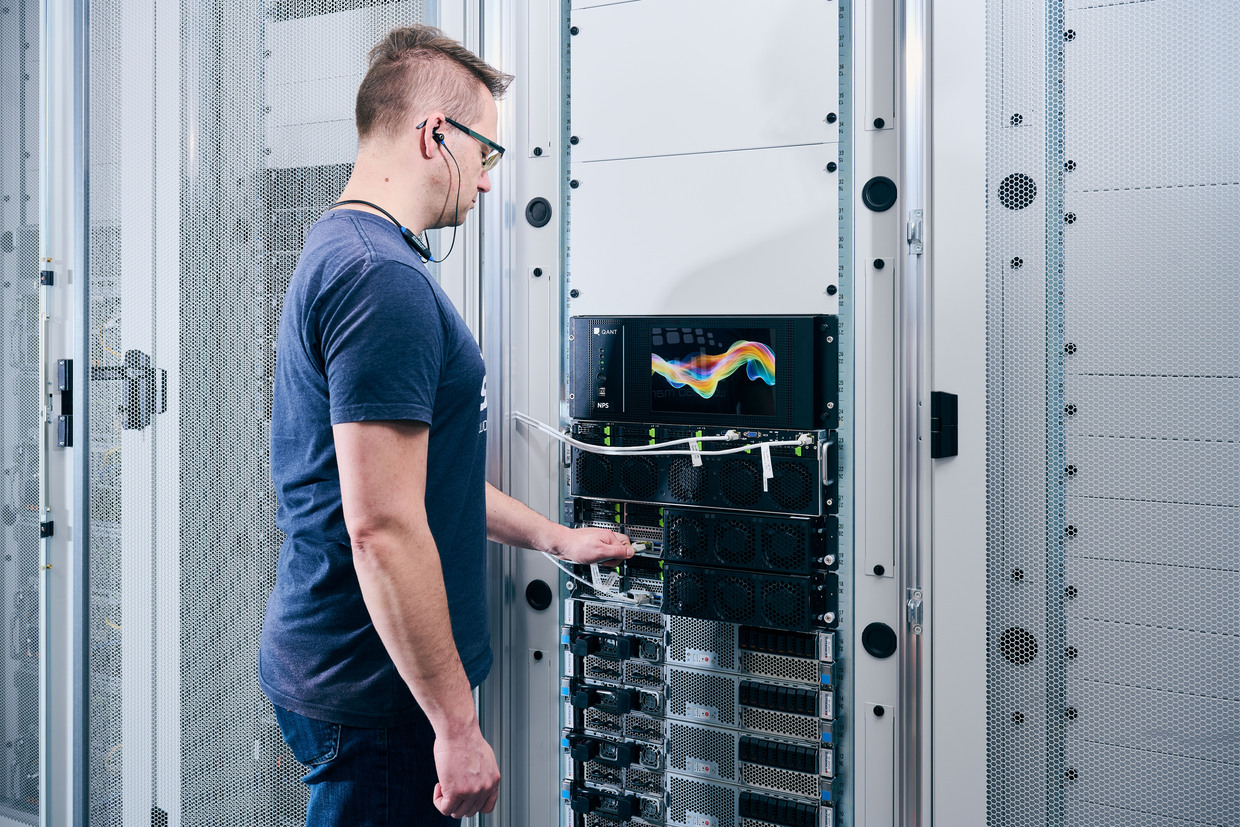
Artificial intelligence, complex logistics, and the control of energy systems often reach their limits in terms of computation time and energy consumption today. A test system for photonic computing has gone live at the Karlsruhe Institute of Technology (KIT), designed to make AI and other computationally intensive applications significantly faster and more energy-efficient.
To meet ever-increasing computing demands while dealing with limited energy resources, the technology uses light instead of electrical signals to process information.
In the new system, photonic processors complement traditional high-performance computers. Unlike conventional chips, they process information not with electric currents but with light signals. This allows them to perform certain computational operations particularly efficiently and is considered a promising approach for artificial intelligence applications and other data-intensive tasks.
Researchers at KIT are now investigating in which applications the light-based processors can best demonstrate their strengths and how they can be integrated into existing computing infrastructures as accelerators. “Access to photonic processors opens up new possibilities for us to make computationally intensive applications more efficient,” says Professor Martin Frank, director of the Scientific Computing Center ( SCC ) at KIT. “We combine classical computers, quantum computers, and light-based systems with the target of executing each subtask on the hardware best suited for it.”
Greater Efficiency Through Combining the Strengths of Different Systems
“A key focus of our research is on hybrid solution strategies. If we efficiently distribute complex calculations across the available hardware types, we can arrive at results faster overall and with less energy,” adds Professor Ina Schaefer from KIT’s Department of Informatics and the KASTEL - Institute of Information Security and Dependability. “At the same time, we make our results available as open source so that other researchers can benefit from them as well.”
The Federal Ministry of Research, Technology and Space is providing approximately 4.3 million euros in funding for the development of the test system. The hardware was procured as part of the QuSol quantum computing project and was developed and manufactured by the Stuttgart-based company Q.ANT.