
Former KIT Professor Alexander Waibel Joins AI Dialogue with Pope Leo XIV
- author:
- place:
- date: 16.11.2026
Retired Professor Alexander Waibel was among the international AI experts who met with Pope Leo XIV at the Vatican to discuss the responsible development of artificial intelligence.
At a high-level Vatican conference on the future of artificial intelligence held in late October, leading international AI researchers met with Pope Leo XIV to discuss the societal opportunities and risks of intelligent technologies. Among the invited experts was former KIT professor Alex Waibel.
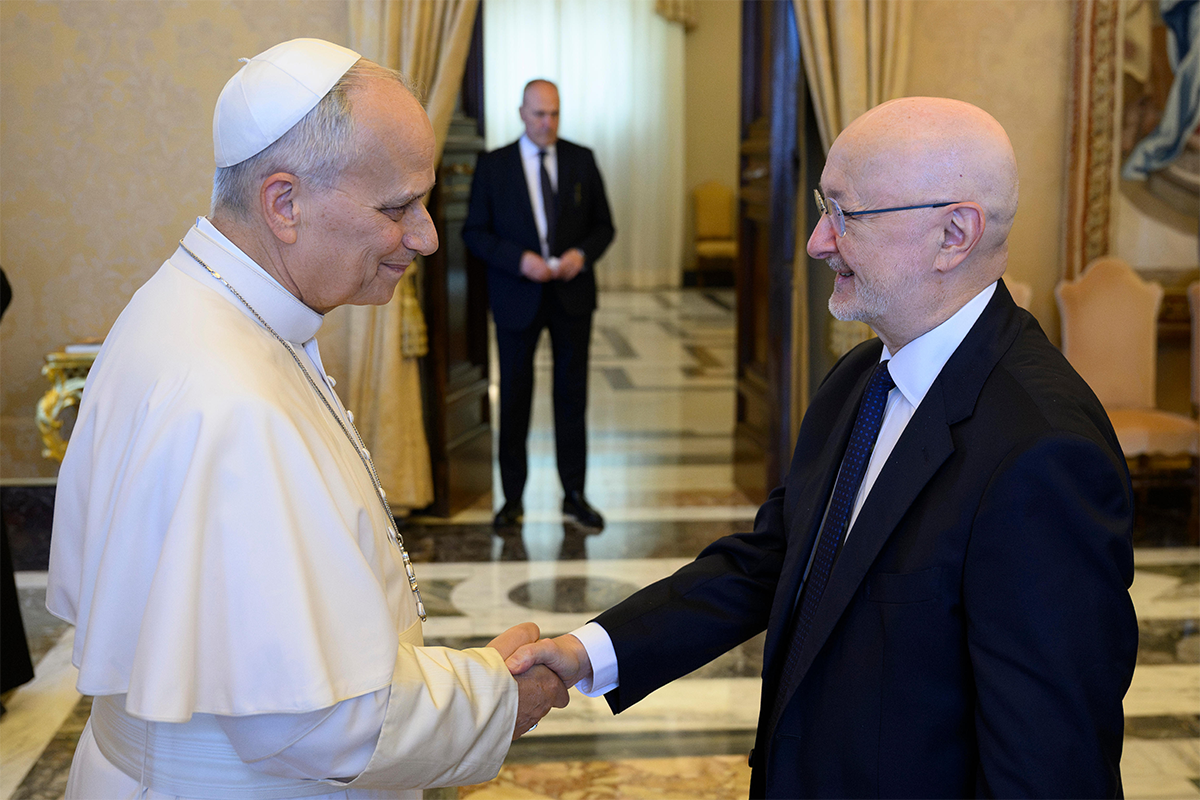
Prof. Alex Waibel meets with Pope Leo XIV at the Vatican, where leading international experts discussed the future of artificial intelligence.
As early as September 2025, Waibel was a member of a twelve-person international “AI Round Table” that drafted the “Global Appeal for Peaceful Human Coexistence and Shared Responsibility – Fraternity in the Age of AI.” The document was presented to the Pope and served as an important foundation for the encyclical “Magnifica Humanitas,” which Pope Leo XIV published in May 2026. In it, he calls for technological development to be consistently guided by human dignity, responsibility, and the common good.
In late October 2026, the expert group met again at the Vatican and exchanged views with the Vatican Commission on Artificial Intelligence. During a private audience, the scientists presented the Pope with a joint briefing on current challenges and possible guidelines for the responsible development of AI. In his contribution, Waibel advocates for a pragmatic and human-centered approach to AI. Instead of blind faith in technology or blanket rejection, he calls for independent standards to assess the safety, transparency, and social responsibility of intelligent systems. At the same time, he warns of the social consequences of an increasingly digitized world. In particular, he says, greater consideration must be given to the risks of loneliness, a loss of direction, and the loss of meaning and interpersonal connection. Waibel emphasizes that technology should serve people and not replace human relationships.
AI Research by Alexander Waibel at KIT
During his time at the Karlsruhe Institute of Technology (KIT), Prof. Waibel had a significant impact on research in the divisions of artificial intelligence, natural language processing, and machine translation. Many of the foundations of today’s applications—such as real-time translation, automatic subtitling, and multilingual speech dialogue systems—stem from the work of his research groups. To this day, Waibel remains one of the world’s leading scientists in the Division of language-based AI and intercultural communication.